

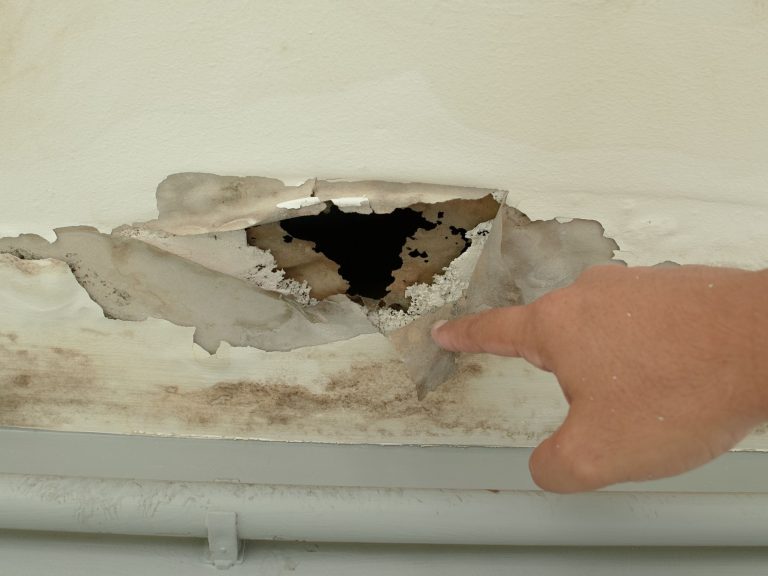
Many people believe that using a shop vac, opening windows, and running fans to dry out water damage is enough. Unfortunately, this is not the case. Water can seep into walls and under flooring, causing damage that is not immediately visible but that will manifest later in the form of mold and rot. This can end up costing more in repairs and insurance claims.
What “dry” actually means after a flood
When you have a surface that feels dry when you touch it, you’re getting very little information about the materials that actually make up your structure. Water is constantly moving by capillary action deep into the cellular structure of drywall, studs, and subflooring, where it will pool without ever appearing on the surface. A wall cavity can store pounds of moisture while the painted surface seems bone dry within a day.
This is why psychrometrics is so critical. The process of drying out a structure has nothing to do with how much air is blown over the surface, and everything to do with how temperature, airflow, and relative humidity can be controlled across all materials in a drying stack until each layer’s moisture content is reduced to acceptable levels. Water damage pros use moisture meters to determine whether wood and drywall have internalized enough water to develop instability and mold, and FLIR cameras to see through walls and find water pockets without guessing and tearing everything out, neither of which can simply be bought at the popular hardware store down the road.
The mold clock starts faster than you think
According to FEMA, mold can begin to form on damp indoor surfaces within one to two days of water exposure. Most homeowners are surprised to learn that mold can begin growing that soon. In the amount of time it takes to rent, study up on, and set up equipment to dry out a room, adequate time to prevent mold growth has often already passed.
Household box fans don’t move enough cubic feet per minute of air through open wall cavities and flooring into structural framing to ensure you won’t have mold and dozens of other issues. The fans blow over surfaces; they don’t draw humidity out of wood fibers. Room dehumidifiers capture surface humidity in small areas; the powerful drying equipment used by professionals can draw out deep-seated moisture and reduce humidity pervasively.
Black mold (_Stachybotrys chartarum_) is particularly dangerous in this context. It doesn’t grow in visible, open areas – it takes root inside wall cavities and underneath flooring where moisture hides longest. By the time you see it, the remediation job has grown significantly more complex.
Not all water is created equal
Most homeowners may not be aware but there is a classification system for water damage categories. Category 1 water is the cause of damage due to broken supply lines from appliances. Category 2, or gray water, is from showers, appliances, sinks, etc., and may have chemical or biological contaminants. Category 3 water is also known as black water and is from sewage backups or toilet overflows. This water contains pathogens, bacteria, and toxins well above the acceptable standard for regular household cleaning and will require specialized equipment and cleaning agents.
A large percentage of home flooding involves Category 2 or 3 water. If you treat this kind of contamination as a simple mopping and drying job you’re risking a genuine biohazard being left behind. Successful mitigation requires antimicrobial treatments, containment, personal protection, and often removal of affected materials as they cannot be adequately cleaned. These treatments and procedures are covered under IICRC S500 standards, which are the procedural standards and guidelines in the Water Damage Restoration, Cleveland, OH industry.
The insurance problem no one mentions until it’s too late
The most expensive consequences of DIY moisture damage cleanup happen when homeowners file insurance claims. If a homeowner files a mold or secondary water damage claim with their insurer weeks after the fact, the adjuster will ask for documentation. They want dry logs – records of moisture readings taken at numerous points during the mitigation process, showing the home was brought back to appropriate moisture content levels according to industry criteria. If dry logs aren’t available, the claim can be denied.
A homeowner who spent two weekends drying the basement with box fans and a rented dehumidifier doesn’t have dry logs. There’s also no thermal imaging report documenting whether the home’s wall cavities are still wet. The claim gets denied, and the repairs come out of pocket. Insurers are typically more than justified in denying such claims, as a DIY job on any but the smallest water incursion is highly likely to leave moisture behind. A specialized firm generates this kind of documentation on every job, as a routine part of the mitigation process. This paperwork regularly makes the difference between a covered claim and a five-figure out-of-pocket repair.
What prolonged moisture does to a structure
Hidden moisture is not inactive. It keeps seeping unnoticed into those wooden studs, joists and subflooring. A few drops every minute get absorbed, transported, and then reabsorbed, until suddenly a gaping hole can be poked through a softened, weakened surface with a fingertip or a shattered subfloor crumbles onto basement concrete.
None of this is visible during the early stages. That’s the nature of moisture damage – the consequences arrive well after the obvious water is gone, and well after the moment when intervention would have been straightforward.
The real cost of DIY drying
It’s natural to think that you can save money by managing water damage cleanup on your own. After all, insurance will only cover so much – why not do what you can and save the rest? The problem with this mentality is that water damage does a lot more than simply make things wet. Left untreated, it can cause rot, corrosion, structural damage, and worst of all, dangerous mold growth. These conditions cost far more to repair – both in money and aggravation – than eliminating the moisture right away would. For your health and the health of your home, it’s recommended that you work with professional water damage cleanup specialists to handle all cleanups, regardless of size.